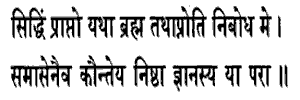
| 50. How he who
has attained perfection reaches Brahman, that in brief do thou learn from Me,
O son of Kunti,that supreme consummation of knowledge. The perfection he has
already attained consists in the body and the senses being prepared for devotion
to knowledge as a result of the Grace of the Lord worshipped through his duty.
Reference to this (perfection) serves as a prelude to what follows: What is
that perfection to which that reference forms a prelude ?It is the process
of jnana nishtha, or devotion to knowledge, by which he attains Brahman, the
Supreme Self. That process, the, way to the attainment of jnananishtha, do
thou understand with certainty from my speech: Is it to be described at length
?No, says the Lord ; it will be described only in brief. Absolute perfection
is the consummation of Self know ledge. What the attainment of Brahmanreferred
to in the words bow he reaches Brahmanis, the Lord proceeds to specify in the
words that supreme consummation of know ledge. Consummation (nishtha) means
perfection, the final or highest stage. (Question) : Consummation of what ?(Answer):Of
Brahmajnana or knowledge of Brahman.(Question):Of what nature is the consummation
of .Brahmajnana ?(Answer):Of the same nature as Atmajnana or Self knowledge.(Question):
Of what nature is the Selfknowledge 1(Answer):Of the same nature as the Self.(Question):Of
what nature is the Self ?(Answer) ;Of the nature described by the Lord and
in the passages of the Upanishads, and (ascertainable) by nyaya or reasoning
(upon the scriptural texts).Is Selfknowledge possible at all ?(Objection):Knowledge
or cognition (jnana) is of the form of its object. But it is nowhere admitted
that the Self is an object of cognition or has a form.(Answer):The Self has
a form, as taught in the scriptural passages. |