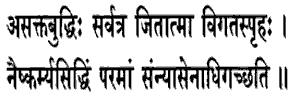
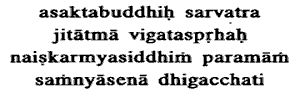
| 49. He whose reason
is not attached any where, whose self is subdued, from whom desire has fled,
he by renunciation attains the supreme state of freedom from action.He whose
reason (budhi, antahkarana) is free from attachment to sons, wife, and other
objects of attachment, whose self (antahkarana) is brought under his own control,
from whom desire for the body, for life, and for pleasures has fled; a person
of this sort who knows the Self attains to the supreme perfection, to absolute
freedom from action (naishkarmyasiddhi), by samnyasa. In virtue of his know
ledge of the unity of the actionless (nishkriya) Brahman and the Self, all
actions have fled from him. This is known as the state of absolute freedom.
from action ; and it is a siddhi or perfection. Naishkarmyasiddhi may also
mean the attainment (siddhi) of naishkarmya, the state in which one remains
as the actionless Self. It is supreme as distinguished from the perfection
attainable by KarmaYoga ; it is the state of immediate liberation (sadyomukti).
This state is attained by samnyasa or right knowledge,or better still; by the
renunciation of all actions for which one is prepared by his right knowledge,
and so says the Lord in v.13. Now, the Lord proceeds to teach how a man who,
having attained perfection (as described above in xvi. 46) by performing his
duty (as taught above) in the service of the Lord, has come by the discriminative
knowledge of the Self, can attain the perfection known as naishkarmya or absolute
freedom from action, i.e a firm unswering stand in the knowledge of the pure
Self. |