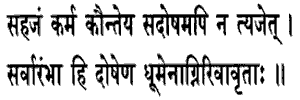
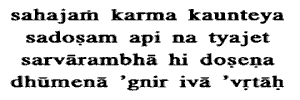
| 48. The duty born
with oneself, O son of Kunti, though faulty, one ought not to abandon; for,
all undertakings are surrounded with evil, as fire with smoke.Born with oneself
; born with the very birth of man. Faulty: as everything is composed of the
three guess. All undertakings: whatever the duties are ; by context, ones own
as well as others duties ; for. the reason here assigned is that they are all
made up of the three gunas· Though a man my perform anothers duty, abandoning
what is called his own duty, the duty born with himself, he is not free from
fault ; and anothers duty brings on fears And since it is not possible for
any man who does not know the Self to give up action entirely, therefore he
ought not to abandon action (karma). Is entire renunciation of action possible
? (Now, let us enquire): Is it because of the impossibility of entire abandonment
of action that no one ought to renounce ones own (natureborn) duty, or is it
because some sin t accrues from the abandoning of the duty born with oneself
?(Question):Now, of what good is this enquiry ?(Answer):In the first place,
if the duty born with one self ought not to he abandoned (merely) because of
the impossibility of renouncing action entirely, then it would follow that
there can be nothing but merit in renouncing it entirely. The Sankhya, Buddhistic
and Vaiseshika theories.(Objection):Yes ; but an entire renunciation is not
possible.Is the soul (Purusha) always mobile like the gunas of the Sankhyas
? Or, is action itself the actor (soul), like the five Skandhas of the Buddhists,
undergoing destruction every moment In either case, an entire renunciation
of action is impossible.Now there is also a third theoryWhen the thing (soul)
acts, then it is active ; when it does not act, then it is actionless. |