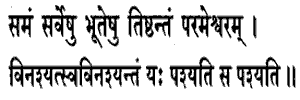
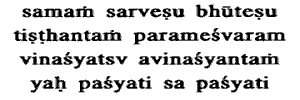
| 27. He sees who
sees the Supreme Lord remaining the same in all beings, the undying in the
dying.The Supreme Lord exists, without any difference, in all living beings,
from Brahma down to the unmoving object (sthavara). He is the Lord Supreme
as compared with the body, senses, Manas, Buddhi, the Avyakta (the unmanifested,
i.e the causal body, the karanasarira, avidya) and the individual soul Atman,
Jiva). All living beings are perishable while the Supreme Lord is imperishable.
Thus there is a great disparity between the Supreme Lord and the create
beings. For, of all changing states of a being (bhava vikaras), the change
of state called birth is the root ; all the other changes ending with destruction
occur subsequently to birth. There can be no change of state subsequent
to destruction, since the object itself does not exist. attributes can exist
only when the substance exists. Wherefore, the denial of the final change
of state comprehends the denial of all the preceding changes as well as
their effects. Thus it may be seen that the Supreme Lord is quite unlike
all beings and that He is one and immutable in all. He sees (rightly) who
sees the Supreme Lord as now described.(Objection):The whole world sees
; why this one in particular ?(Answer):True, the world sees; but it sees
erroneously. Hence the particularization he alone sees. A man whose eye
is affected with timira sees more moons this one ; and with reference to
him, he who sees one moon may be specified thus, he alone sees Similarly
here, be who sees the one undivided Self as described above is distinguished
from those who erroneously see many distinct selfsin the words he alone
sees. Others, though seeing, yet do not see, inasmuch as they see erroneously
like those who see more moons than one. knowledge of the one Self leads
to moksha. |