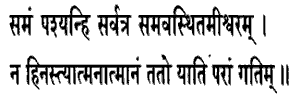
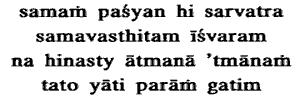
| 28. Because he
who sees the Lord, seated the same everywhere, destroys not the self by
the self therefore he reaches the Supreme Goal. He who realizes that the
Isvara described in the last preceding verse is the samei. e he who sees
that he dwells in all creatures alikedestroys not his own self by himself.
Because be does not destroy the self, he reaches the Supreme Goal, he attains
moksha.(Objection):No living being whatever destroys itself by itself. Where
then is the necessity for the denial He destroys not the self by the self,
any more than for the prohibition t fire should be consecrated not on earth,
not in the sky, not in heaven (Tait. Sam. 5·27) ?(Answer):This objection
does not apply here ; for, the necessity may be explained on the ground
that ignorant men are guilty of ignoring the Self. An ignorant man ignores
the Self who is quite manifest to all, selfmanifested, and directly visible,
and he regards the notSelf (physical body, etc.) as himself. Having performed
good and evil works (dharma and adharma), he kills even this self (the physical
body, etc,) which he bad accepted and accepts another new self ; he kills
this again and accepts another and so on ; thus he goes on killing every
new self that he has accepted. An ignorant man is, accordingly, a slayer
of the self. Even the real Self is Always killed by avidya, inasmuch as
there is no perceptible effect of His existence. Thus, all ignorant men
are but Knowledge destroys ignorance, and with it all evil is destroyed.
On the destruction of nescience (ajnana) and false knowledge (mithya. jnana),
the two veil that have hidden the true nature of the Self, the sage attains
the highest goal, the highest end of man, the Supreme Bliss (Paramananda).
|