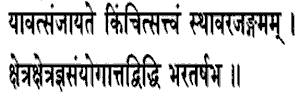
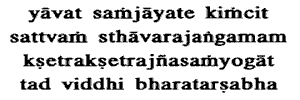
| 26. Whatever
being is born, the unmoving or the moving, know thou, O best of the Bharatas
that to be owing to the union of Kshetra and Kshetrajna(Objection):Of what
sort is this union of Kshetra and Kshetrajna meant to be ? The union of
Kshetrajna with Kshetra cannot certainly be a relation through contact (samyoga)
of each others parts, as between a rope and a vessel, inasmuch as Kshetrajna
is, like the akasa, without parts. Nor can it be of the nature of samavaya
or inseparable inherence, inasmuch as it cannot be admitted that Kshetra
and Kshetrajna are related to each other as cause and effect.(answer):The
union between Kshetra and Kshetrajna, between the object and the subject,
which are opposed to each other in nature, is of the nature of mutual adhyasa
; i. e it consists in confounding them as well as their attributes with
each other owing to the absence of a discrimination between the nature of
Khetra and that of Kshetrajna, like the union of a rope and a motherofpearl
respectively with a snake and silver when they are mistaken the one for
the other owing to the absence of discrimination. The union of Kshetra and
Kshetrajna which is of the nature of adhyasawhich consists in confounding
the one with the otheris a sort of illusion (mithyajnana) ; and this illusion
vanishesbecause of its opposition to the right knowledge when a man attains
to a knowledge of the distinction between Kshetra and Kshetrajna as defined
in the sastra, when he is able to separate Kshetrajna from Kshetra like
the ishika reed from the munjagrass and to realize that Brahman, the Knowable,
which is devoid of all upadhis as described in the words It is not said
to be existent or nonexistent (xiii.12) is his own Self, when he is convinced
that, like the elephants and palaces projected by a jugglers art, or like
a thing seen in a dream. |