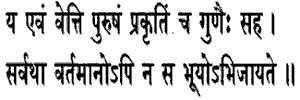
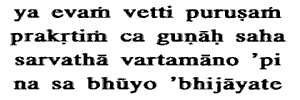
| 23. He who thus
knows Purusha and Prakriti together with qualities, whatever his conduct,
he is not born again.He who knows Purusha in the manner mentioned above
i.e he who directly perceives Him as his very Self, This I am, he who knows
Prakriti or Avidya described above t with all its modifications, he who
knows the Prakriti as resolved into nothing (abhava) by vidya or knowledge,
whatever life he may lead, (i.e, whether he is engaged in the prescribed
duties or forbidden acts), he is not born again ; that is, he will not have
to put on another body on the death of this, i.e, at the end of the birth
in which he has attained wisdom. How much more so the wise man who stands
firm in the path of duty !(Objective):What acts are neutralized by knowledge?Absence
of rebirth subsequent to the attainment of knowledge has indeed been taught
here. But, inasmuch as it is not right (to. suppose) the annihilation, before
producing their respective effects, of those acts which were done (in the
present birth) before the attainment of knowledge or of those acts which
may be done thereafter, or of those which had been done in the many past
births, there should be at least three (more; births ; for it is not right
to suppose the annihilation of these acts any more than to suppose the annihilation
of the deeds whose fruits are being reaped in the present birth. And we
see no distinction between (those two groups of) acts. Accordingly. the
three classes of acts will give rise to a single birth. Otherwise, the possibility
of annihilation of what has been done would lead to uncertainty everywhere,
and the sastra (all scriptural injunctions) would become useless. Wherefore
it is not right to say that he is not born again(.answer):No, (it is right),
as the following passages of the sruti show:His deeds perish. |