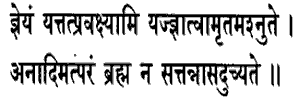
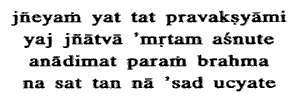
| 12. That which
has to be known I shall describe; knowing which one attains the Immortal.
Beginningless is the Supreme Brahman. It is not said to be sat or asat.That
which has to be known, I shall fully describe as It is.The Lord then goes
on to describe what the result of that knowledge will be, in order to call
the hearers attention by way of creating in him a desire to know of It.
It, the unsurpassed One, the Brahman, just spoken of as That which has to
be known, has no beginning. With a view to avoid tautology some split the
expression anadamatparam into anadi matparam, and explain it differently
; thus: Brahman is beginningless, and I am Its ParaSakti, the Supreme Energy
called Vasudeva. (But we say)True, tautology might thus be avoided, provided
the given interpretation were possible. But the interpretation does not
hold good, for it is intended here to expound the nature of Brahman by denying
all specific possessed of a particular kind of energy and at the same time
as devoid of all specific attributes. Therefore tautology should be explained
as due to the exigencies of the metre. Brahman is beyond speech and thought.
After saying that He is going to speak of what, as leading to immortality,
is worth knowing, and after having thus called the hearers attention by
creating a desire for the , knowledge, the Lord says: lt. is not said to
be sat (existent) or · asat (nonexistent).(objection):After proclaiming
very loudly that He is going to speak of the Knowable, it does not Become
the Lord to describe It as neither sat nor asat.(answer):No ; it is quite
the right thing that has been said.How ?Thus: being inaccessible to speech,
Brahman, the Knowable, is defined in all Upanishads only by a denial of
all specialties, Not and not gross, not subtle in the terms It is not this.
|