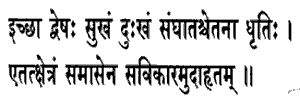
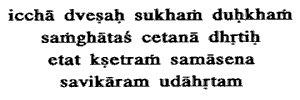
| 6. Desire, hatred,
pleasure, pain, the aggregate, intelligence, courage ;the Kshetra has been
thus briefly described with its modifications.Now, the Lord proceeds to
teach that even those which the Vaiseshikas speak of as the inherent attributes
of Atman (the Self) are merely the attributes of Kshetra (matter), but not
the attributes of Kshetrajna (the knower of matter): Desire (ichchha) is
that which impels a person who has once experienced a certain object of
pleasure to seekon again perceiving an object of the same class; to get
hold of this latter as conducive to pleasure. This, namely desire, is a
property of the inner sense (antahkarana) ; and it is Kshetra (matter) because
it is knowable. So also, hatred is that which leads a person, who once experienced
a certain object of pain, to dislike an object of the same class on perceiving
this latter. This, namely hatred, is only Kshetra (matter), because it is
knowable. Pleasure is the agreeable, the tranquil, made up of the Sattva
principle. Even this is Kshetra. because it is knowable. Pain is the disagreeable
; and it is Kshetra because it is knowable. The aggregate is the combination
of the body and the senses. Intelligence is a mental state which manifests
itself in the aggregatejust as fire manifests itself in a burning realistic
mass; pervaded by the semblance of the consciousness of the Self. It is
Kshetra, because it is knowable. Courage is that by which the body and the
senses are upheld when they get depressed ; and it is Kshetra because it
is knowable.Desire and other qualities mentioned here stand for all the
qualities of the inner sense (antahkarana). The Lord concludes the present
subject as follows: the Kshetra bas been thus briefly described; with its
modifications such as Mahat (Buddhi). |