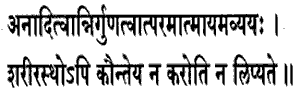
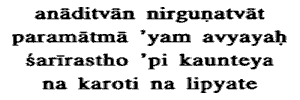
| 31. Having no
beginning, having no qualities, this Supreme Self imperishable, though dwelling
in the Body, O son of Kunti: neither acts nor is tainted.The Self has no
beginning, no cause. That which has a cause perishes by itself, whereas
This (Self) does not perish, because, as having no cause, He is without
parts. Further, He does not perish because He is without qualities ; for
that which has qualities perishes by loss of qualities; whereas the Self
does not perish, because He is devoid of qualities. Thus the Supreme Self
imperishable He suffers no destruction. Therefore, though dwelling in the
body,the Self is said to dwell in the body because the Self is manifested
in the body, yet He does not act. Because He does not act, He is not affected
by the results of acts. The meaning is this:He that is an agent is affected
by the fruit of the act ; but this (the Self) is a nonagent and is therefore
not tainted by the fruit of action.(Objection):Who, then, in the bodies
acts and is tainted If, on the one hand, an embodied self, distinct from
the supreme Self, acts and is tainted, then the identity of Kshetrajna with
the Isvara spoken of in such places as xiii. 2 would be inexplicable. If,
on the other hand, there is no embodied self distinct from the Isvara, then
tell me who acts and is tainted: or say that the Isvara is not Supreme.
On the ground that the doctrine or the Upanishads taught by the Lord is
thus in every way difficult to understand and difficult to explain, it has
been abandoned by the Vaiseshikas, as well as by the Sankhyas, the Arhatas,
and the Buddhists.(.answer):As regards this objection, the following answer
has been afforded by the Lord Himself. |